
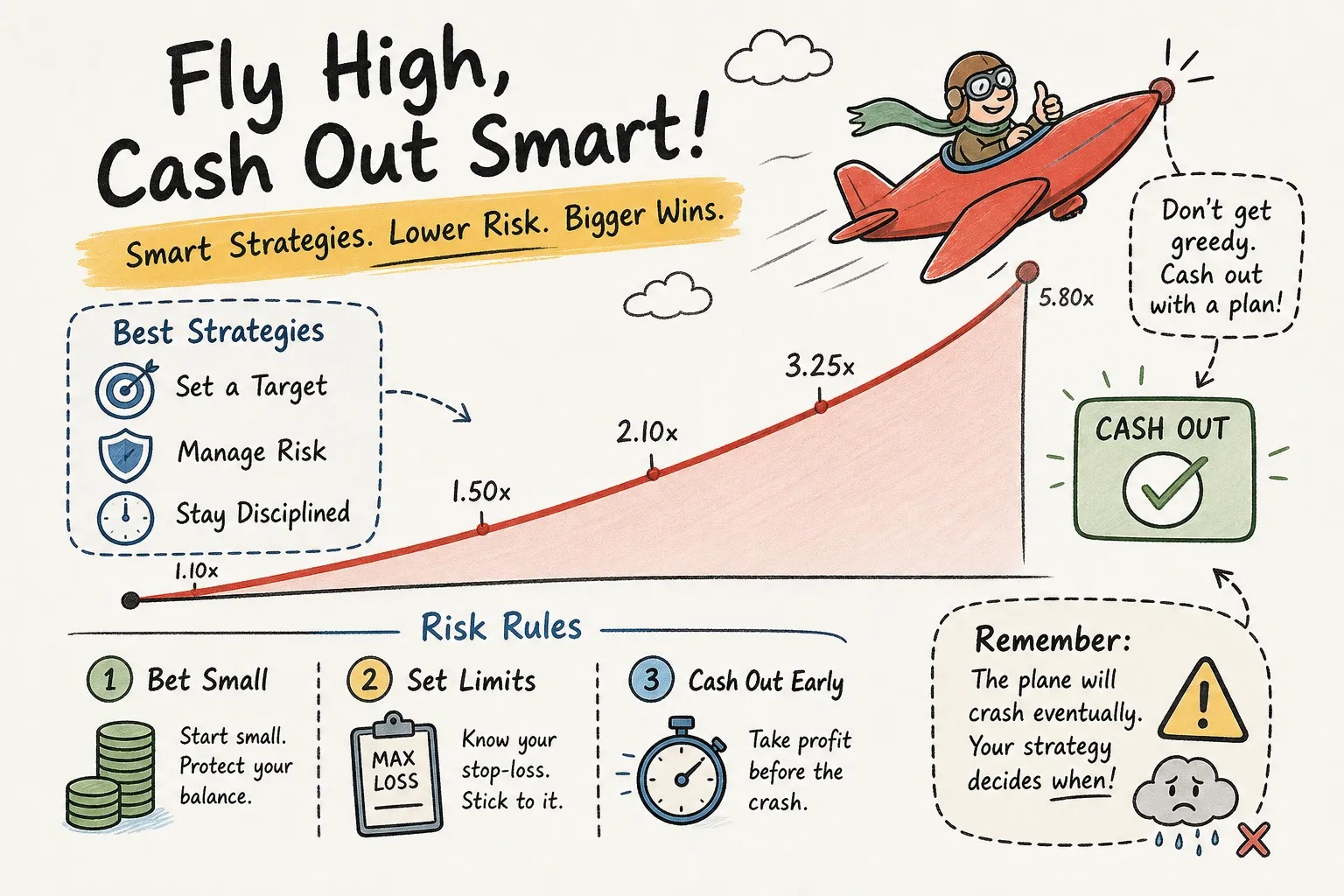
What is the best strategy for Aviator betting? Most Kenyan punters sit down to play Aviator expecting a simple ride. The plane goes up, you cash out, you profit. What actually happens for a lot of players is a session bankroll gone in under 20 minutes, and the blame lands on bad luck. The reality is more uncomfortable: it’s usually bad strategy, or no strategy at all.
No approach you use in Aviator will erase the house edge. That’s not a limitation of your skill; it’s mathematics baked into the game. But the right Aviator betting strategy, paired with strict bankroll rules, determines whether you get 20 minutes of play or 120 minutes, whether you protect your deposit or watch it vanish on a string of early crashes. This guide uses Kwikbet’s Aviator to frame every example, so the numbers and features referenced are what you’ll actually see when you log in.
By the end, you’ll know exactly how each of the four main strategies works, what the real risk profile looks like for each, and which bankroll rules to attach to them. That’s a better foundation than most players ever build.
How Aviator Actually Works: RTP, House Edge, and Multiplier Reality
What the 97% RTP Really Means for Your Wallet
Aviator runs at a 97% RTP, which means the game is designed to return KSh 97 for every KSh 100 wagered over a very large number of rounds. The house edge is 3%. That figure sounds small, but it compounds quickly when you’re placing dozens of bets per session. More importantly, 97% RTP is a long-run average across thousands of rounds, not a session guarantee. Your individual session can run well above or well below that figure depending on variance.
The house edge also doesn’t care which cash-out multiplier you target. Whether you’re aiming for 1.5x or 10x, the long-run expected loss per unit wagered stays the same. Strategy doesn’t change that number; it changes how the loss arrives and how long your bankroll survives the journey.
How Often Aviator Reaches Common Multipliers
Anchoring your strategy in real frequency data changes how you approach each round. Based on the crash game survival model consistent with Spribe’s Aviator design, here’s what the multiplier distribution looks like across a large sample of rounds:
- Crashes below 1.5x:
approximately 33, 34% of rounds
- Reaches 2x:
roughly 50% of rounds
- Reaches 5x or higher:
about 20% of rounds
- Instant crash at 1.00x:
roughly 1% of rounds
Use these as planning inputs, not predictions. Each round is an independent event. A run of five high multipliers does not make the next crash more or less likely. Players who believe otherwise fall into the gambler’s fallacy, and that belief drives some of the most expensive decisions made in crash games.
What Is the Best Strategy for Aviator Betting? The 4 Main Approaches, Broken Down
Auto Cash-Out at Low Multipliers (1.5x, 2x Target)
Set your cash-out to trigger automatically at 1.5x or 2x, and the bet settles before you have to make a manual decision. On a KSh 100 stake with a 2x target, a successful round pays KSh 200. The appeal is obvious: frequent small wins, low anxiety, and no manual timing pressure. The tradeoff is equally clear. At a 2x target, you need to win roughly 50% of rounds just to break even, and one-third of rounds crash before 1.5x. Small wins do not survive many early crashes without a disciplined stake size attached.
The Double Bet (Martingale) Method
After each loss, you double your stake until a win recovers what you’ve lost. Starting at KSh 50, four consecutive losses push your next stake to KSh 800. Five losses push it to KSh 1,600. The logic sounds clean on paper: one win eventually recoups everything. The problem is that losing streaks that feel improbable happen regularly in crash games. The plane can crash at 1.00x. It can crash below your cash-out target three, four, five times in a row without any statistical anomaly occurring. Martingale makes those streaks catastrophic rather than manageable.
Two-Bet Low-High Split
Split your stake into two simultaneous bets: a conservative bet set to auto cash-out around 1.5x, and a second bet left to ride toward a 5x or higher multiplier. The low bet acts as partial insurance. If the plane crashes early, you recover a portion of the round’s cost. If it runs high, the second bet captures a
meaningful return. This suits punters who want real action without the exponential exposure of martingale. Kwikbet’s two-bet interface makes it straightforward to run both positions in parallel, so you can set up the split and let the system manage execution.
Staircase (Gradual Scaling) Method
Increase your stake in small steps after wins, and return to your base stake after any loss. This is the opposite of martingale. After a KSh 50 win, you might move to KSh 60, then KSh 75, then back to KSh 50 when you lose. The appeal is that it captures upside during a winning streak without creating catastrophic doubling exposure. The limit is honest: it does not change expected value. The math still runs at 3% house edge. What it does is smooth the ride, protect you from runaway losses, and let you take advantage of variance when it runs in your favor.
What Simulations Reveal About Each Strategy’s Real Risk
Martingale’s Bankruptcy Problem in Hard Numbers
Simulations consistently expose the gap between how martingale sounds and how it performs. In one 20,000-run study using classic martingale, the probability of successfully doubling a session bankroll was approximately 35%. The median point at which a bankroll was exhausted was 170 rounds. That’s not a comfortable buffer when Aviator rounds run fast and the table minimum disappears quickly during a doubling sequence. Because crash games have a hard floor where the plane can crash at 1.00x, losing streaks arrive faster than in traditional even-money casino games. The math that makes martingale look viable in theory collapses faster in practice here than almost anywhere else.
Why Low-Variance Strategies Still Lose Over Time
A common misconception is that frequent small wins equal profitable play. They don’t. If the game runs at 97% RTP, any strategy that keeps playing enough rounds trends toward that negative return, regardless of how smooth the session looks. Fixed 1.5x auto cash-out reduces the speed of loss and limits catastrophic sessions, but it does not flip the underlying math. The purpose of a crash game strategy is loss management and session extension, not profit generation. A good strategy keeps you in the game longer and gives variance time to work in your favor. It does not change which side of the expected value equation you’re on.
Bankroll Rules That Keep You in the Game Longer
How Much to Stake Per Round
The concrete rule is 1, 2% of your session bankroll per round. If you deposit KSh 500 for a session, your base stake is KSh 5, 10 per round. That gives you 50, 100 rounds before a total wipe, enough depth to see variance play out and for your chosen strategy to get a real test. Staking above 2% per round compresses your session dangerously fast. Five consecutive early crashes at a 5% stake and your session is over before you’ve found any rhythm.
Setting Your Stop-Loss and Stop-Win Before You Start
Both limits need to be decided before the first round, not adjusted mid-session when emotions are running. For stop-loss, a practical rule is 30, 40% of your session deposit. On a KSh 500 deposit, that means stopping when you’ve lost KSh 150, 200. For stop-win, a target of 25, 50% profit on your session budget is realistic and disciplined: if your KSh 500 grows to KSh 625, 750, stop or bank the profit. Add a time cap to both. Set a session limit of 30, 45 minutes and exit when the clock runs out, regardless of where your balance sits. These three controls together, stake size, stop-loss, and time limit, are what separate a managed session from a depleted deposit.
Can You Predict Aviator Outcomes? The Honest Answer
What “Provably Fair” Actually Means
Aviator uses a commit-and-reveal fairness system. Before each round, the server commits to a cryptographic hash of the outcome using SHA-512. After the round ends, it reveals the seed so you can verify the result matched the original commitment. This system proves that the outcome wasn’t altered after the fact. It is an auditing tool for completed rounds. It does not expose what the next round will produce before it happens, and it was never designed to.
Why Aviator Predictor Apps Don’t Work
No third-party app can know the next crash point. The server seed is hidden until after the round ends, and a correct cryptographic implementation makes past results mathematically useless for predicting future ones. Any app claiming to forecast upcoming multipliers is doing one of three things: selling noise, fitting patterns to historical data retroactively, or exploiting confirmation bias in players who remember the hits and forget the misses. Downloading or paying for these tools is a double loss, the subscription fee upfront and the failed “predictions” that follow. There’s also a device security risk in installing unvetted third-party software. Avoid them entirely.
Practicing These Strategies on Kwikbet Aviator
Why Kwikbet Suits M-Pesa Players Practicing Aviator
Kwikbet’s Aviator runs on mobile without requiring a desktop or separate app download. For punters betting on the go, that matters. M-Pesa deposits process instantly, so you can fund a session and be in the game in under two minutes. When you hit your stop-win target and decide to exit, M-Pesa withdrawals move fast rather than sitting in a days-long pending queue. Speed of payout matters when discipline is your edge, because the temptation to keep playing shrinks when you can actually move your winnings out immediately.
Features That Support Disciplined Play
Kwikbet’s auto cash-out feature makes the low-multiplier and two-bet strategies covered in this guide easy to implement without clicking manually every round. Set your target once and the system handles execution, which removes the emotional timing errors that cost players money when they hesitate or get greedy mid-flight. The game history panel lets you review recent rounds and check whether your stake sizes and cash-out points are staying within your pre-set rules. Kwikbet holds BCLB license number
BK-0001133, meaning the platform is regulated under Kenyan law. For players who want assurance that RTP claims are backed by an accountable, licensed operator, that regulatory standing matters.
The Core Message to Take Into Every Session
No Aviator strategy changes the 3% house edge. What your strategy does is determine how that edge arrives and how long your bankroll survives it. The four approaches covered here each have a distinct risk profile: auto cash-out at low multipliers gives you frequent small results with lower drama; martingale gives you short-term recovery potential with serious bankruptcy risk; the two-bet split balances insurance with upside; and staircase scaling smooths progression without the catastrophic exposure of doubling.
None of them beat the game, but some manage a session far better than no plan at all.
Two rules are non-negotiable regardless of which Aviator betting strategy you choose: stake 1, 2% of your session bankroll per round, and set your stop-loss before you place your first bet. Everything else is adjustable. Those two rules are not. They’re the difference between a session that ends on your terms and one that ends when your deposit does.
Head to Kwikbet’s Aviator game, set your limits before you start, and pick the strategy that matches your risk tolerance. So what is the best strategy for Aviator betting? It’s a disciplined framework: keep stakes at 1, 2% per round, set stop-loss and stop-win limits before you begin, and choose an approach that matches your risk tolerance. That’s the edge disciplined players actually have, not a formula that beats the odds, but a system that keeps you in control of the ones you’re working with.