
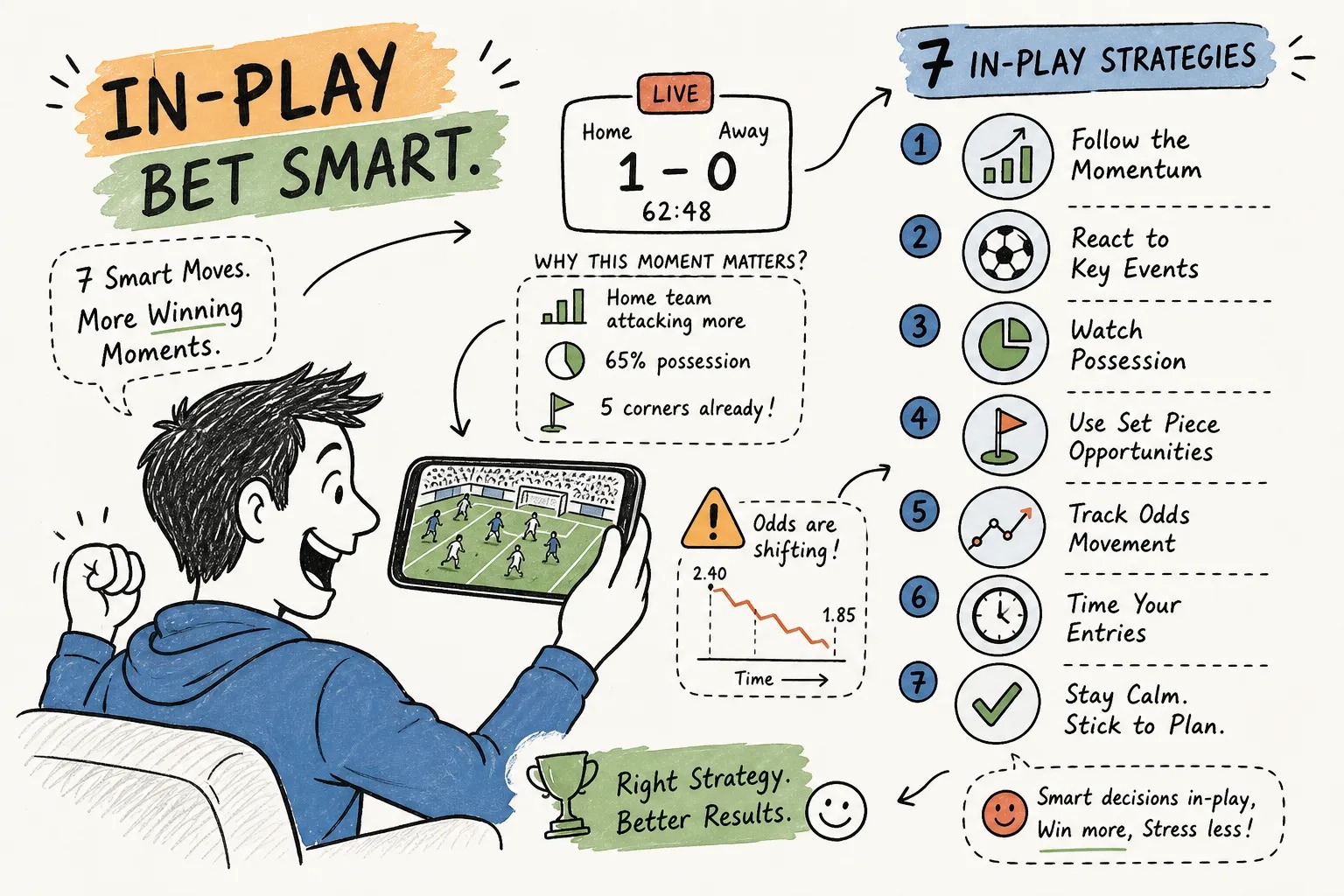
So, what is the best strategy for in-play football betting? The short answer: build a small set of pre-planned, data-driven triggers, momentum reads, xG-based entries, lay-the-draw executions, and apply them with strict bankroll discipline. Pre-match betting locks you in before a single ball is kicked. You pick a team, accept the odds, and spend 90 minutes watching events you can’t react to. Live betting flips that model entirely: you now have real information to work with, and the market constantly re-prices based on what’s actually happening on the pitch. That gap between information and price is where sharp punters make their money.
The platform you use matters. A low-latency provider with wide in-play market selection lets you actually execute these tactics without fighting lag or finding your target market unavailable. Kwikbet’s live betting section is built for that kind of execution, real-time odds updates and a broad range of live football markets without the friction. So does the approach you bring to it: without a disciplined framework, even the best platform won’t save you.
This guide covers seven tactics for in-play football betting: the market signals that trigger each one, the statistics that sharpen your timing, and the bankroll rules that keep you in the game long-term. Pick two or three that suit your risk profile and apply them consistently.
Why live betting demands a completely different mindset
The punter who waits too long in a live market loses the value. The one who acts on instinct without a framework bleeds money fast. Both extremes lose, and most bettors swing between them without realizing it. The winning approach is a pre-planned set of triggers, not real-time improvisation.
The biggest mistake pre-match bettors make going live
Most punters carry their pre-match habits straight into live markets. They bet on gut feel after a goal, or they ignore what the match data is showing them entirely. The pace of in-play betting makes these habits expensive. A live bet needs to be treated like a trade, with a clear entry point, a defined exit plan, and a fixed risk amount. It’s not a hope; it’s a decision with logic behind it.
What gives sharp live bettors their edge
The structural advantage in live betting is simple: the market often lags behind what’s actually happening on the pitch. Real-time data like expected goals (xG), shot counts, and possession shifts updates faster than bookmaker algorithms fully adjust. That lag creates windows where the price on offer is better than
the true probability of an outcome. Sharp bettors aren’t smarter than everyone else, they’re watching the data and acting before the market catches up.
What is the best strategy for in-play football betting? Start by reading the odds
The most reliable signal in live betting isn’t your opinion of a team. It’s the movement of odds triggered by real events. The key is learning to interpret those moves correctly rather than reacting to them emotionally.
What happens to odds after a goal, red card, or substitution
Each event type moves the market at a different speed and magnitude. A goal causes a fast, sharp reprice: the scoring team shortens, the opponent drifts, and industry tracking data consistently shows the scoring team’s win probability increases by roughly 25% on average. A red card triggers a large adverse move for the ten-man side because it materially changes that team’s ability to score or defend for the remainder of the match. A substitution usually causes a modest adjustment, unless a key attacker enters or exits and the tactical shift is obvious.
Identifying when the market has overreacted
The core skill here is spotting a line that has moved more than the event actually warrants. Run a simple mental filter: does this odds movement reflect the real change in the match, or did the market panic? A goal in the 88th minute when a team is already dominant is very different from a goal at the 20-minute mark in a tight game. The magnitude of the price shift should match the magnitude of the impact on remaining play, and when it doesn’t, that gap is where value bets appear.
The three in-play strategies that deliver consistent results
These three tactics cover different risk profiles and different match scenarios. Learn all three, then decide which ones match how you want to bet.
Lay the draw: how to enter, wait, and trade out
The lay-the-draw strategy works like this: you bet against the draw on a betting exchange, wait for a goal to push the draw price higher, then back the draw at the new price to lock in profit. Selection criteria are specific, look for matches with average goals of 2.5 or above and draw odds sitting between 3.50 and 5.00, with strong liquidity so you can exit cleanly. Enter the lay position just before kickoff or at halftime when the score is still level.
After a goal lands, the draw odds rise sharply. That’s your exit window. Back the draw at the new price and you’ve locked in a return regardless of the final result. The main risk is a goalless match: if the game stays 0-0, your lay position remains exposed. A stop-loss rule at the 60-minute mark, or simply exiting for a managed loss if the game looks unlikely to produce a goal, keeps that risk controlled. More aggressive traders run a “let it run” variation after the first goal, holding the position and hoping for a second goal to push the draw price even higher before greening up.
Next-goal betting: targeting short windows of momentum
Next-goal markets let you bet on which team scores next rather than the final outcome. This makes them well-suited to momentum plays: a team pressing hard after conceding, sustained attacking signals like multiple corners in quick succession, or a substitute striker who just entered and is pressing the defense. The decision is based entirely on what is happening right now, not on the pre-match odds or the story of the first half. The window is short, the logic is clear, and the market is re-pricing in real time off the same information you’re watching. The optimal window length varies by match context, so focus on the current phase of play rather than assuming a fixed time frame.
Momentum betting: backing the team in control of the match
Momentum betting means backing the team currently dominating the match, regardless of what the pre-match storyline said. Look for a team with superior xG in the last 15 minutes, a high dangerous attack count, and a goalkeeper under sustained pressure. This isn’t about backing the pre-match favorite. It’s about backing the team winning the match right now, at a price that hasn’t fully adjusted to reflect their control. The pre-match narrative is irrelevant once the ball is moving.
Using live match statistics to find your entry point
Opinions don’t win live bets consistently. Data does. The question is which statistics actually predict short-term goal probability and which ones just add noise to your decision-making.
xG, shots on target, and dangerous attacks: what matters most
The ranking among in-play metrics is well established. xG is the strongest predictor because it measures shot quality, not just volume. A shot from 30 yards out and a one-on-one with the goalkeeper are not the same chance, but raw shot counts treat them equally. Shots on target are the second-best proxy: they filter out wayward attempts but still don’t capture shot quality. Dangerous attacks indicate pressure but are noisier because they don’t confirm that pressure is translating into genuine scoring chances.
Possession alone is the weakest signal for predicting the next goal; a team can dominate the ball and still be getting outchanced in the final third.
Reading the live stats dashboard in real time
When you’re watching a live match on Kwikbet, focus on the last 15 minutes of xG and shots on target rather than the full-match totals. A team can dominate for an hour and then concede control entirely. Recency is what counts for predicting the next goal. Scan quickly, note which team is generating genuine chances in the current phase of play, then act on the price before the market adjusts. Over-analyzing every metric slows your decision down past the window of value.
When to cash out and when to let your bet run
Cash-out is one of the most misused features in live betting. Used at the right moment, it protects profit and limits damage. Used emotionally, it guarantees you exit winning positions early and lock in losses that didn’t need to happen.
The right time to take the cash-out
Cash-out makes sense when the momentum has clearly shifted against your original position, a key player off the pitch, a late defensive weakness exposed, or the match situation materially different from when you entered. It also makes sense when the sportsbook’s offer is close to the full potential payout and meaningful risk still remains. Timing matters: cash-out value drops fast after major events, so if a red card or injury changes your position, act quickly rather than waiting for the market to settle.
When holding the bet is the smarter play
Cashing out is the wrong move when your original analysis still holds and the odds have only moved because of minor events. Sportsbooks build a margin into every cash-out offer, so you’re typically accepting slightly worse than fair value when you take it. The principle is straightforward: cash out based on match reality, not emotional discomfort. If the reason you placed the bet is still valid, hold the position.
Bankroll rules that keep you in the game long-term
Every tactic in this guide fails without discipline behind it. Bankroll management isn’t the exciting part of live betting, but it’s the part that separates punters who last from punters who don’t.
Stake sizing for live betting: the 1, 3% rule
The standard professional rule is to stake 1, 3% of your total bankroll per bet, with disciplined live bettors typically sitting at 1, 2% for in-play positions. The range sits lower for in-play betting than pre-match because the market moves fast, emotions run high, and the temptation to over-stake after a big moment is constant. Flat staking at 1, 2% per bet removes that temptation by making the decision before the
game starts, not in the heat of a live moment. Stake size should go down when the bankroll shrinks, never up to chase losses.
Setting session limits and stop-loss rules before kickoff
Decide before the match starts how many in-play entries you’ll take and what your maximum session loss is. A weekly loss cap of 10 units, where each unit represents 1% of your bankroll, means a bad run never does serious damage. These rules need to be set cold, before the match kicks off, because in-play tilt is real: a late goal or a red card can destroy decision-making fast if there’s no hard limit in place. Set these boundaries in advance using whatever tools your sportsbook provides, and treat using them as a mark of professionalism, not weakness.
Put the plan together before the whistle blows
If you’re still asking what is the best strategy for in-play football betting, here’s the practical answer: pick two or three of the approaches above, define your entry and exit triggers before kickoff, and back every decision with flat staking and hard loss limits. Reading odds shifts, laying the draw, riding momentum with xG data, timing your cash-out, each of these works. None of them works without the discipline to execute consistently.
A full game plan with clear entry and exit logic turns a chaotic live market into a structured set of decisions. That’s when the live market starts working for you rather than against you.
Kwikbet’s live betting section gives you real-time odds updates and a wide range of in-play football markets to act on these tactics. Set your limits, pick your strategy, and back your analysis with discipline.