
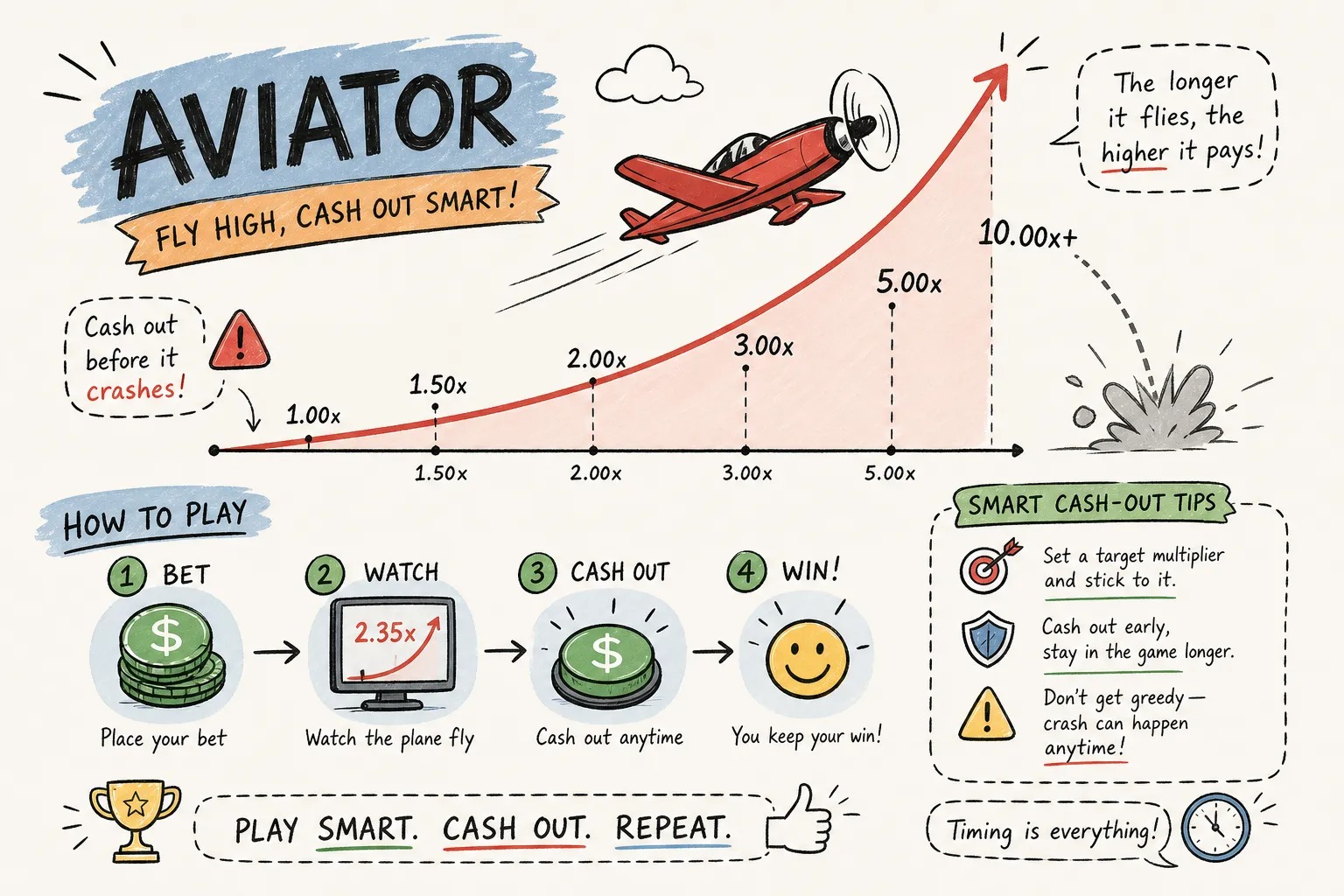
A plane takes off, a multiplier climbs, and you cash out before it flies away, or you lose your stake. If you’re learning how to play Aviator, that one-sentence rule set is the entire game. The simplicity is the point, and it’s also the trap. Many players who don’t yet understand the probability behind the multiplier climb tend to bail too early and leave money on the table, or hold too long and watch their stake disappear.
This guide walks you through exactly how Aviator works, round by round, then covers the real odds behind the multiplier numbers, cash-out approaches worth testing, and how to verify the game is running fairly. If you want a licensed platform to practice on, Kwikbet is a BCLB-regulated sportsbook in Kenya where Spribe’s Aviator is available with fast M-Pesa deposits and withdrawals. By the end of this article, you’ll have a clear mental model of the game and a set of beginner-friendly strategies supported by verifiable probability figures.
How to Play Aviator: Round-by-Round Rules
Every Aviator round follows the same fixed loop, and understanding that loop removes any sense of mystery from the game. The round begins with a short betting window, research from Spribe’s documentation puts this at approximately five to seven seconds. During this window, you set your stake, confirm it, and optionally configure an auto cash-out target. You can place up to two simultaneous bets in the same round, each with its own cash-out settings and its own payout calculation.
Bet window and auto cash-out
When the window closes, the plane takes off and the multiplier starts at exactly 1.00x. From there it climbs continuously with no fixed ceiling and no visible pattern. The climb is not fixed or predictable; it’s driven by a random number generator that determines the crash point before the round even starts, a mechanic you can verify yourself through the provably fair system covered later in this guide. At some point the plane flies away, which is the crash event. Any bet still open at that exact moment is lost in full, with no partial payout.
Crash mechanics and RNG
The most important mechanic to understand is this: your payout is set by the multiplier displayed at the exact moment you click cash out, not by where the plane eventually crashes. If you cash out at 3.00x and the plane crashes at 8.00x a second later, your payout is still 3.00x your stake. The final crash number is irrelevant once you’ve exited. That one rule changes how you should think about every decision in the
game.
How to Place Your First Bet on Kwikbet’s Aviator
Opening Aviator on Kwikbet takes you directly to a live table shared with other players. You’ll see the current multiplier climbing in real time, a bet panel at the bottom of the screen, and a live feed of recent crash results on the side. Before your first round, deposit using M-Pesa through the standard deposit flow, Kwikbet’s platform processes M-Pesa deposits quickly, and your balance typically reflects within moments of confirmation.
To place a bet, type your stake into the bet input field during the countdown window. Keep your first few sessions at the minimum stake while you develop a feel for the multiplier speed and the timing of manual cash-outs. In those early rounds, pay attention to how often the multiplier clears 1.5x versus crashing below it, that pattern builds intuition faster than reading about it will. Rushing your stake up before you understand the rhythm is the most common beginner mistake.
Auto cash-outis the feature beginners should enable first. You set a target multiplier before the round starts, and the game cashes you out automatically the moment that level is reached, even if your attention drifts. On a small mobile screen, manual cash-out timing is harder than it looks, and a missed tap can cost you a session’s worth of gains. Auto cash-out removes that problem entirely. Set it, confirm your bet, and the game handles the exit for you.
If you want to use both bet slots in a single round, a reasonable starting setup is one bet with a conservative auto cash-out at around 1.5x to 2.0x and a second bet targeting a higher multiplier. This lets you experience both sides of the game in the same round without committing your full balance to one outcome.
How to Play Aviator: Cash-Out Strategy
Every cash-out decision in Aviator is a trade-off between frequency and size of return. Cashing out early means winning more often but collecting smaller profits each time. Waiting for a big multiplier means larger individual wins but long stretches of empty rounds in between.
At a 1.5x target, the round reaches that level roughly 65% of the time based on Spribe’s published 97% RTP model. That means you’ll collect a small profit on about two out of every three rounds, but the gain is only half your stake each time. The rounds where the plane crashes below 1.5x erase those small gains quickly, so you need a consistent hit rate to stay above water.
Chasing multipliers above 5x requires patience most beginners don’t have. At 5.0x the probability per round drops to around 19%, and at 10.0x it falls to roughly 9.7%. That means you can expect multiple consecutive rounds without hitting a 10x target, which puts real pressure on your bankroll between wins. Players who target 10x or higher without a strict session budget tend to burn through their balance before
the big hit arrives.
The split-bet approach is a practical middle ground. Set Bet A to cash out at a conservative 1.5x to 2.0x, and let Bet B run for a higher target. Bet A covers part of the round’s cost if Bet B crashes, and Bet B provides upside if the multiplier keeps climbing. This isn’t a profit guarantee, but it takes the all-or-nothing pressure off every single round and makes sessions easier to manage emotionally.
What the Real Odds Look Like: Multiplier Probabilities and House Edge
Aviator publishes a 97% RTP, which means the house edge is 3%. According to Spribe’s RTP documentation, the probability of reaching any given multiplier follows a straightforward approximation: roughly 0.97 divided by the target multiplier. Here’s what that looks like in practical terms:
1.5x:
approximately 65% chance per round (hits about 2 in every 3 rounds)
2.0x:
approximately 48.5% chance (roughly 1 in 2 rounds)
3.0x:
approximately 32% chance (roughly 1 in 3 rounds)
5.0x:
approximately 19% chance (roughly 1 in 5 rounds)
10.0x:
approximately 9.7% chance (roughly 1 in 10 rounds)
100.0x:
approximately 0.97% chance (roughly 1 in 100 rounds)
One figure worth memorizing separately is the instant crash probability. About 3% of rounds, roughly 1 in 33, crash at or below 1.00x, meaning no player can cash out at all. This is where Martingale-style doubling strategies get destroyed: a string of low crashes can hit before any recovery bet wins, and an instant crash offers zero exit opportunity regardless of your strategy.
A 3% house edge is competitive for a crash gambling game. For a Kenyan player wagering 100 KES, it means the game returns 97 KES on average across many rounds. The edge doesn’t apply to each individual round; it’s a long-run trend. Short sessions can and do beat it. The longer you play, the more the math trends toward that 3% cost, which is why session limits matter.
Bankroll Approaches That Protect Beginners from Bad Streaks
Flat staking is the most reliable starting approach for new players. Choose one stake size and one auto cash-out target, then repeat that combination consistently across your session. It sounds straightforward, but that’s exactly the point. Flat staking prevents the emotional escalation that follows a losing streak, where raising your bet to recover losses accelerates the damage rather than reversing it.
Before you start any session, set a loss limit and commit to stopping when you hit it. Worth emphasizing: the feeling that a win is “due” after several crashes is not based on how the game works. Each round is independent, and the game has no memory of your previous results. A session loss limit protects you from the part of the brain that ignores that fact under pressure.
Martingale betting, where you double your stake after every loss, is the approach most likely to end a session catastrophically. In theory, one win recovers all previous losses. In practice, a five-round losing streak at the 2.0x target, which has a 52% chance per round of NOT hitting, can happen within the first twenty minutes of play. Combine that with an instant crash and your stake has doubled several times with zero cash-out opportunity. Keep stakes flat, keep sessions short, and treat the 3% house edge as the cost of entertainment rather than an obstacle to overcome through system play.
How to Verify Aviator Is Provably Fair
Provably fair is a cryptographic system that lets you confirm a round’s result was fixed before bets were placed and was not changed afterward by the operator. Aviator uses this system, and verifying it takes only a few minutes once you know the steps.
Before each round starts, the game generates a server seed and shows you its SHA-256 hash, a unique fingerprint of that seed. Because you see the hash before takeoff, the operator cannot secretly change the seed after bets are placed without the hash also changing. That’s the commitment mechanism. After the round ends, the actual server seed is revealed. You can then run SHA-256 on that revealed seed yourself and confirm the output matches the pre-round hash. If it matches, the seed was locked in before the round began.
To run this check, open the round in the game’s History or Provably Fair panel and copy the pre-round hash along with the revealed server seed. Paste the revealed seed into any SHA-256 calculator, online or local, and compare the output to the pre-round hash character by character. Most BCLB-licensed platforms, including Kwikbet, provide a built-in verification tool in the game interface so you don’t need external software to complete the check.
One important limitation: provably fair verification confirms the commitment and reproducibility of a specific round. It doesn’t audit the operator’s entire RNG system across all rounds. It’s a strong integrity check, not a complete guarantee of system-wide fairness, so playing on a licensed, regulated platform remains the most important layer of protection.
Play with a Plan, Not a Feeling
Aviator is a one-decision game: bet, watch the multiplier, and cash out. Everything in this guide, the odds, the cash-out timing, and the provably fair verification, is context for making that one decision well and consistently.
The numbers are real. A 2.0x target hits roughly half the time. A 10.0x target hits roughly 1 in 10 rounds. Instant crashes wipe roughly 1 in 33 rounds with no exit possible. Auto cash-out and flat staking protect you from the emotional pressure that turns those numbers into losses faster than the math alone would. And provably fair verification means you can confirm every round’s result yourself rather than taking the platform’s word for it.
Now that you know how to play Aviator, the next step is putting it into practice. Kwikbet offers Spribe’s Aviator on a BCLB-licensed platform with fast M-Pesa deposits, quick withdrawals, and built-in responsible gambling tools including session limits and a dedicated support helpline. Start with the minimum stake and enable auto cash-out at 2.0x for your first ten rounds, watch how the multiplier behaves before you adjust any settings.
The game rewards patience and punishes impatience. Now you have the numbers to know the difference.